Ti minutter
For adults
The school and you teach your child to read together. If you practise ten minutes a day together, and you also read aloud from a book, your child is well on the way to becoming a strong reader.
What ten minutes looks like
Sit next to each other, so you can both see. Let your child keep a finger on the word being read. That makes the line easier to follow.
Start with the words. Your child points at each letter, says the sound and blends the sounds together. If the word will not come, you say only the first sound and let your child try to carry on. Keep going until every word has been read, with or without help.
Then the whole text, all in one go. Read it twice if you can: the first time to get the words right and the second time to read it as a whole.
Finally the three questions under the text. The first one has its answer written in the text, the second has to be worked out from it, and the third is about your child's own life and has no right answer. That is where the conversation can carry on while you clear the table.
Then ten minutes have passed.
When the word will not come
Wait
Let your child try alone. Blending the sounds into a word takes time, and the seconds that pass are not wasted. Count to five inside your head before you help. It feels longer than it is.
Help
If the word will not come, say only the first sound of the word, that is s in sol. Often that is enough for the rest to fall into place, and then it is your child who read the word.
Praise
Praise the effort rather than the result. "You kept going even though it was hard" says more than "you are so clever". Your child cannot decide whether they are clever, but they can decide whether to keep going.

Sounding out means putting a sound on each letter and blending them into a word. That is what happens when your child says sss-ooo-lll and then sol.
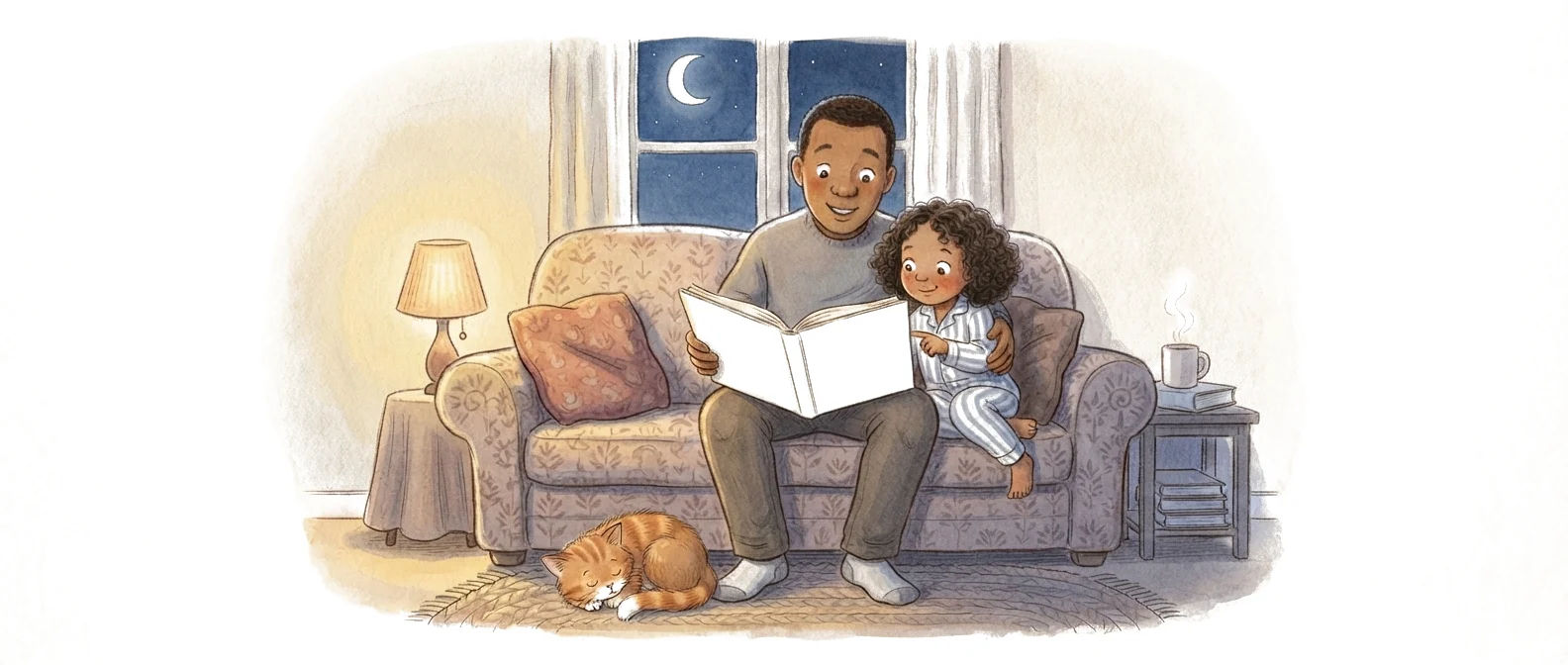
Read aloud to your child as well
Keep reading aloud, also after your child has started reading alone. The two things do different jobs. When your child reads alone, they practise decoding. When you read aloud, they hear sentences and words that are longer than they can manage themselves, and those are the ones that build the language.
Ten minutes of reading alone and a little reading aloud at bedtime makes a good evening.
Talk about the book while you read
Stop a couple of times along the way and say something like this:
- "What do you think happens now?"
- "What is that called?" while you point at the picture.
- If your child says "dog", repeat the answer in more words: "Yes, a big, wet dog."
- "Have you ever tried anything like that?"
Read the same book several evenings in a row. Most children ask for the same book again anyway.
Reading passport and worksheets
Print the passport and put it on the fridge. Your child does the colouring: a star for the ten minutes you practised, and a moon for the bedtime story. Bring the passport to school when it is full.
The passport fits on one A4 sheet. Print it in colour if you can, but it works in black and white too.
A worksheet for every step
Exercises
Small exercises you can do alongside the reading. The exercises with letters and sounds suit a particular step, and the exercises with words belong to the word box. You can do them in any order you like. The words and sounds are Danish.
Step 1, The letters (Bogstaverne)
Step 2, The first words (De første ord)
Step 3, Short sentences (Korte sætninger)
Step 4, Little stories (Små historier)
Step 5, Longer stories (Længere historier)
Step 6, Words that cheat (Ord, der snyder)
The word box
Library
Borrowing books from a public library in Denmark is free. You need a health card, the yellow one, to sign up, and the staff are used to helping families who are new to the country.
The school library is not enough on its own
The school library is small, and the selection of books at the right level is limited. A child who reads ten minutes a day gets through what is there quite quickly.
The public libraries, on the other hand, have shelves full of beginner books, and that is why it is worth going there regularly.
The children's librarian can help
The larger libraries have a children's librarian who knows the books and is used to finding something that suits the particular child standing at the desk.
Show the step page on your phone and let the librarian see the text your child is reading now. Then they can find books at the same level themselves. That is easier than explaining it, and they are the ones who know the books.
Texts for older readers
Texts that are just as easy to read as the rest, but about something else. They are for the reader who needs the practice and is tired of texts about bees and suns.
Your own language
If a language other than Danish is spoken at home, that is an advantage. Your child stores words and concepts in the same place whatever language they arrive in.
Say the word in your own language too when you come across one your child does not know. Talk about the book in whichever language comes easiest, and let your child retell the Danish story at home in your language. The bedtime story is welcome to be in your language as well.
The words on the steps and the texts stay in Danish. Every word has a sound button, so you can hear how it is pronounced before your child reads it.
Write to us
Do you have a question about the site, a correction or an idea? Write, and we will reply.
About this site
Ti minutter was made by Martin Hasbirk Brandt, a teacher in a Danish primary school. Through JumpAI.dk he runs AI courses for teaching staff and school leaders at independent and private schools.